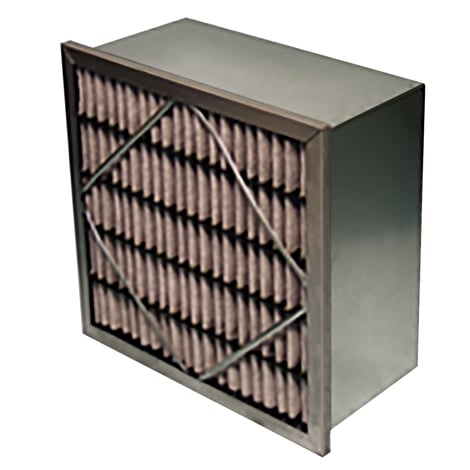
Available in headered or box style, this rigid deep pleat is designed to be a molecular-only filter to remove medium concentrations of most external and internal pollutants.


| Item Type | Width (mm) | Height (mm) | Depth (mm) | Airflow (m3/h) | Pressure drop Average (Pa) |
|---|---|---|---|---|---|
| CitySorb-DP-201-242412-BH | 592 | 592 | 292 | 3400 | 75 |
| CitySorb-DP-201-241212-BH | 287 | 592 | 292 | 1700 | 75 |
| CitySorb-DP-201-242412-PH | 592 | 592 | 292 | 3400 | 75 |
| CitySorb-DP-201-241212-PH | 287 | 592 | 292 | 1700 | 75 |
| CitySorb-DP-202-242412-BH | 592 | 592 | 292 | 3400 | 75 |
| CitySorb-DP-202-241212-BH | 287 | 592 | 292 | 1700 | 75 |
| CitySorb-DP-202-242412-PH | 592 | 592 | 292 | 3400 | 75 |
| CitySorb-DP-202-241212-PH | 287 | 592 | 292 | 1700 | 75 |
| CitySorb-DP-204-242412-BH | 592 | 592 | 292 | 3400 | 75 |
| CitySorb-DP-204-241212-BH | 287 | 592 | 292 | 1700 | 75 |
| CitySorb-DP-204- 242412 -PH | 592 | 592 | 292 | 3400 | 75 |
| CitySorb-DP-204-2 41212-PH | 287 | 592 | 292 | 1700 | 75 |

Using Camfil Life Cycle Cost (LCC) Analysis software, Camfil experts can conduct a comparative analysis of different air filters to provide a comprehensive report on potential savings.
Commercial and public buildings Sustainability Air quality Take a Breath
How do you best protect yourself from air pollution in a city environment? Is it safe to open a window to let the breeze in to cool your premises on a warm day? What about pollutants already present in your indoor air?
Commercial and public buildings Air cleaners and air purifiers Air quality
What does poor air quality in schools do to a child’s health, well-being and ability to learn? Why are children more vulnerable to air pollution than adults? And how can you achieve, or advocate for, a healthy indoor air environment in the classroom?
Commercial and public buildings Air cleaners and air purifiers Air quality

The air in our buildings is often 2-5 times more polluted, and in some cases, even a hundred times more polluted than the air outside. So, where do the pollutants in the indoor air come from and how do we mitigate their impact?
Commercial and public buildings Air cleaners and air purifiers Air quality

The first classification system for molecular filters in general ventilation applications

Dealing with airborne odours, toxins and gases can be a big challenge. Learn about how Molecular Contamination Control and how it can protect against the harmful effects of these airborne contaminants.
Commercial and public buildings Electronics and optics Life science and healthcare Education and experience Manufacturing and machinery Air quality Food and beverage
 Singapore