The Hidden cost of washing air filters
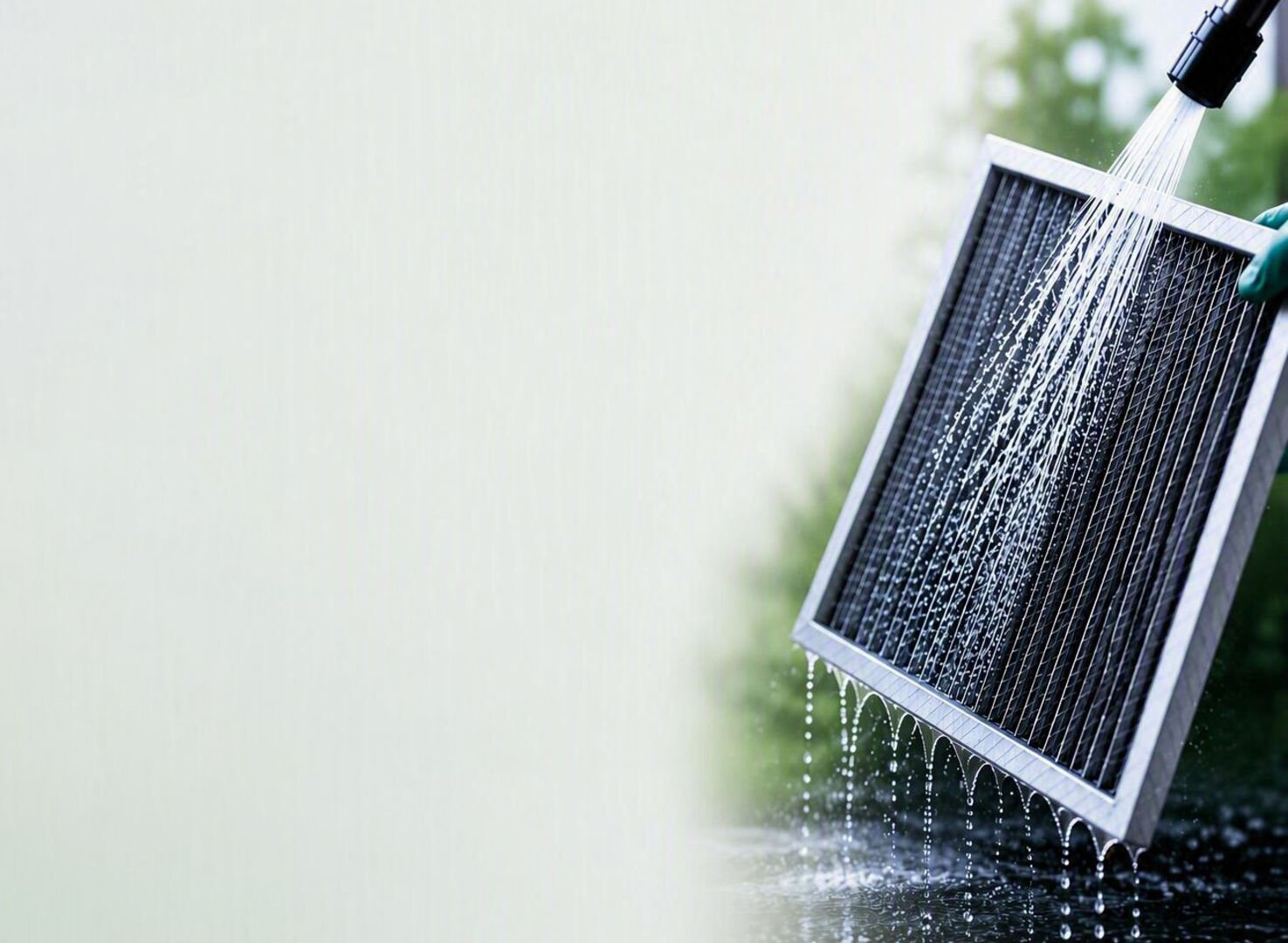
Is a washable air filter really more sustainable? While reusability is often viewed as a sustainability advantage, the full picture is more complex. If repeated washing reduces filtration performance, increases fan energy consumption, and requires water, labour, and maintenance resources, the environmental and operational costs may outweigh the perceived benefits.

Washable air filters are often seen as a better option than disposable ones
Reuse instead of replacing - sounds like the responsible thing to do. Less waste, lower cost. On paper, it makes a lot of sense. But when you look beyond reusability and consider the full lifecycle of a filter, the picture becomes more complex.
Washing can change how a filter performs over time. If particle capture declines or airflow resistance increases, the ventilation system may need more fan energy to maintain the required airflow. The result can be higher operating costs and less predictable indoor air quality.
This raises a more important question: should a filter be considered sustainable simply because it can be reused?
In air filtration, performance matters more than anything else.
While filtration standards focus on performance, building owners and facility managers often need to consider additional factors when selecting a filter:
How efficiently it captures the particles
What's the overall environmental impact
What is the total cost of ownership
In other words, a truly sustainable filtration solution should balance all three.
If washing reduces filtration efficiency or increases resistance to airflow, the impact extends beyond the filter itself. The fan may require more energy to deliver the required airflow, while indoor air quality may become less predictable. Because electricity is consumed throughout the filter's operating life, even a modest difference in resistance can influence both operating cost and environmental impact.Look beyond the purchase price
The total cost of ownership of an air filter includes more than its purchase price. A meaningful comparison should consider the energy needed to move air through the filter, service life, replacement frequency, labour, cleaning resources, downtime and disposal. For washable filters, water use, cleaning effort and drying time should also be included.
Among these factors, energy use can be one of the most important over the filter’s lifetime. Filters designed to maintain low and stable airflow resistance can reduce the demand placed on the fan while continuing to deliver the required filtration performance. Choosing an energy-efficient filter is therefore not only a cost decision. It can also be a more sustainable choice by reducing operational energy consumption without compromising clean-air performance.
Does it perform the same way, every time?
Maybe the better question isn’t: “Can this be reused?” Maybe it’s: “Does it perform the same way, every time?
In many cases, filters designed for consistent performance throughout a defined service life remove this uncertainty. Their energy use, maintenance needs and replacement schedule can be evaluated more clearly, supporting better lifecycle planning.
Before choosing a filter, look beyond whether it can be washed. Compare its filtration performance, airflow resistance, energy demand and total cost of ownership across its full service life. A filter that performs efficiently and consistently may deliver the stronger outcome for both the building and the environment.
Want to find out more?
Related insights

Article•2023.09.25
How usual items and actions affect the air and people

Article•2023.08.11
Insufficient or non-existent laws stand in the way of reducing global air pollution

Article•2021.12.13